Unlisted assets: the four entry points for non-institutional investors

You may have heard that a portion of large fortunes is invested in private companies, that these investments have outperformed the stock market over the long term, and that access has now opened up to private individuals. The figures exist, and they are public. They tell you what has happened, not what will happen. They also do not explain how to get in, or what each entry costs.
The risks are real. Private equity can lead to a loss of capital, and it locks up your money for eight to twelve years, sometimes longer. A poorly sized investment, a poorly chosen vehicle, or a layer of fees that was not properly understood is difficult to correct once the subscription is signed. You cannot simply sell it the next day.
This article describes the four entry points available to a private investor, from professional funds to funds of funds: minimum investment, diversification, liquidity, fees, and the target profile. You will also see how the investment vehicle changes the situation, and what regulations have changed since 2024.
In brief
- Private equity includes venture capital and buyouts, private debt, and infrastructure. Capital is locked up for eight to twelve years, with a return premium that is expected but never guaranteed.
- Over the ten years to the end of 2025, French private equity posted a net IRR of 10.7% per year, compared to 9.5% for the CAC 40 (France Invest, EY, June 2026).
- Four entry points: direct, specialised fund, feeder fund, fund of funds. The lower the minimum investment, the higher the diversification and the more the fees stack up.
- Professional funds generally require 100,000 euros for non-professional investors; authorised retail funds have no regulatory minimum.
- Since 1987, the bottom quartile of funds has posted a net IRR of -2.2% per year, while the top quartile has gained 22.9%. Selection is what drives performance.
- Observed allocations often range from 5% to 20% of financial assets, spread over several vintages. The right level depends on your personal situation.
Private equity is no longer reserved for institutional investors
In recent years, access for private individuals has widened: some private equity funds can be subscribed to with just a few thousand euros. In 2025, French savers invested 3.1 billion euros in private equity funds open to them, including 2.6 billion through life insurance, out of 14.5 billion in total assets (France Invest, April 2026).
Three pieces of legislation opened the door
The European ELTIF 2 regulation, applicable since 10 January 2024, removed the 10,000-euro minimum investment and the 10% portfolio cap previously imposed on individuals for these European long-term investment funds. In 2019, the Pacte Law opened life insurance to private equity funds. Since 24 October 2024, the Green Industry Law has mandated a minimum share of private equity in managed portfolios: 4% for a balanced profile and 8% for a dynamic profile in life insurance, and between 3% and 15% in retirement savings plans depending on the profile and time horizon.
What private banks have built
One must give credit to traditional players for two things: they opened this asset class to their clients long before the regulations did, by negotiating access with major firms, and their selection teams established the analysis standards that are still in use today. The issue is no longer access, but the price and the quality of what you are buying.
Private equity and the stock market: what ten years of data tell us
Over the ten years to the end of 2025, French private equity posted 10.7% net per year, compared to 9.5% for the CAC 40 and MSCI Europe, 8.9% for the CAC All-Tradable, 5.5% for the CAC Mid & Small, and 3.3% for commercial real estate, with the same cash flows (France Invest and EY, June 2026, indices with dividends reinvested, PME method, past performance).
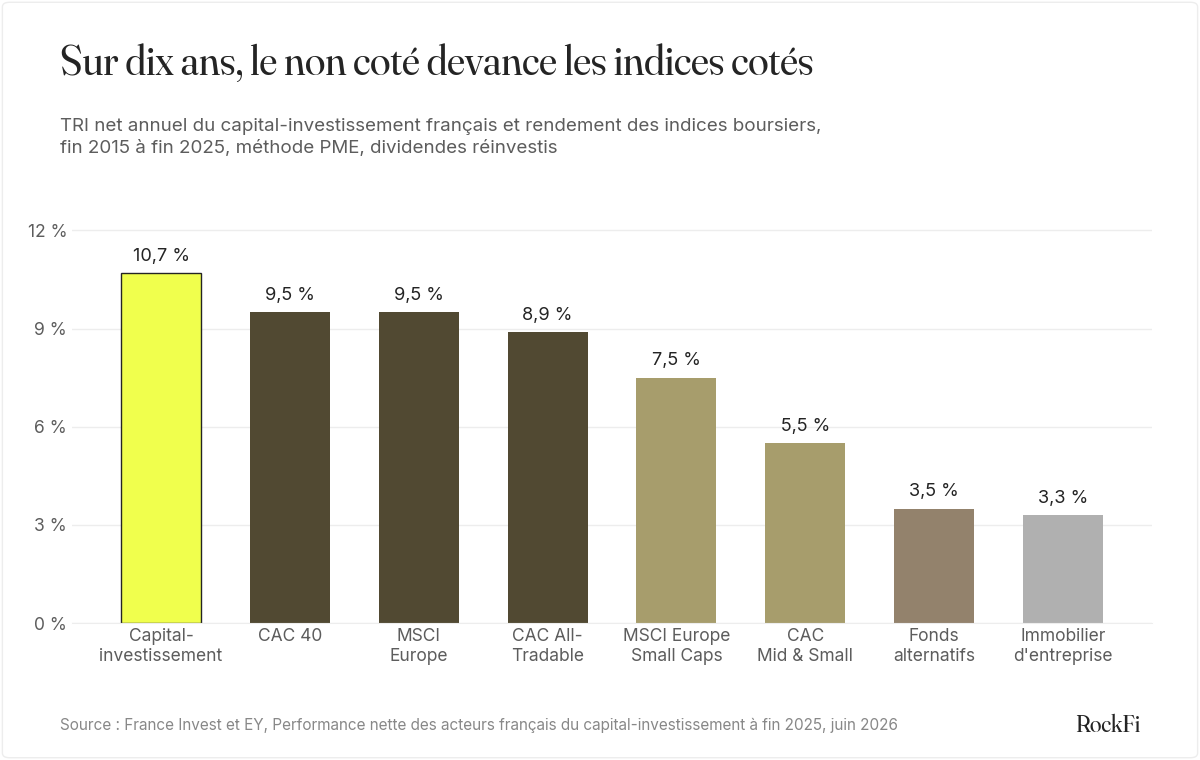
Past performance. It is not an indicator of future results and is not guaranteed.
The four entry points
There are four ways to invest in private equity: directly, through a specialised fund, through a feeder fund, or through a fund of funds. As you move down this list, the minimum investment amount decreases, diversification increases, and fees accumulate.
Direct investment
You purchase shares in a company yourself, either alone or as part of a small group in a club deal (direct co-investment). You know exactly what you own, and you concentrate all the risk on one or two companies. This approach requires sector expertise and the willingness to accept a total loss on the investment. It depends on your investor profile and the structure of the transaction.
Specialised fund
This is the professional vehicle: in France, the FPCI (professional private equity fund) and the SLP (limited partnership). Regulations restrict these to professional investors and individuals who invest at least €100,000 per fund (AMF General Regulation, Article 423-49). A €30,000 threshold exists for certain subscribers who can demonstrate private equity experience. A fund typically holds fifteen to thirty investments, with fees around 2% per annum plus 20% of the capital gain above a certain return threshold.
The FCPR (venture capital mutual fund) authorised by the AMF is the retail version: there is no regulatory minimum and the investment universe is more strictly regulated. It is offered to non-professionals with a Key Information Document (KID) and after verifying that the product is suitable for them.
Feeder fund
A feeder fund invests all its assets into a professional master fund. It serves to lower the entry threshold: where the master fund might require €100,000 or several million, the feeder fund often accepts €10,000 to €30,000, with an additional layer of fees for the structure and its distribution.
Fund of funds
A fund of funds invests in ten to thirty funds managed by different teams, across various strategies and vintages. It does what an individual cannot do alone: diversify across managers. The price: a second layer of fees, generally 1% per annum and 10% of the capital gain.
Four entry points, four balances
The table summarises what each entry point requires and provides. The minimum investment amounts, number of holdings, and fee layers are market estimates: each management company sets its own, and access conditions vary by fund. Please check these in the fund documentation.
Sources: AMF General Regulation; AFG, ELTIF 2 guide, January 2025; France Invest, April 2026. Indicative minimum investment amounts.
The investment vehicle changes the game
The same fund may have different subscription conditions depending on whether it is held in a securities account, a holding company, or a life insurance policy. The vehicle determines the minimum investment, the tax treatment, and sometimes eligibility.
Securities accounts and holding companies
A securities account is the most direct access: you subscribe to the fund as is, with its progressive capital calls. A private holding company does the same and is often used following a business sale, when the proceeds need to be reinvested.
Life insurance, French or Luxembourg-based
The Pacte Law has opened up life insurance to private equity funds within unit-linked policies. For professional funds, the Insurance Code (Article R131-1-2) restricts selection to experienced subscribers or those investing at least 100,000 euros per unit-linked fund, or 5,000 euros within a discretionary management mandate, and limits these assets to 50% of the contract's total value. In return, the insurer provides liquidity according to the contract terms, which the fund alone does not offer. Luxembourg contracts, through their dedicated internal funds, also accept foreign professional funds; however, their fixed costs are often prohibitive for investments below 250,000 euros.
Retirement Savings Plan
Since 24 October 2024, the managed portfolios of new PERs have included unlisted assets: this is often a saver's first exposure to the asset class, even if they did not choose it. The lock-in period until retirement aligns well with the time horizon of unlisted investments.
Good to know. Since the 2026 Finance Act, when a holding company sells contributed shares less than three years after the contribution, the tax deferral under Article 150-0 B ter now requires reinvesting 70% of the sale proceeds within three years and holding the assets for five years (for sales after 24 February 2026). Eligible investments must meet specific criteria. This mechanism carries a risk of tax reassessment: always prepare for it with an advisor, never after the fact.
The cost of each layer, and what remains
Unlisted investments are paid for in layers: the fund's fees, the intermediary vehicle's fees, and the wrapper's fees. For funds open to retail investors, the fees charged reached 2.47% in 2025, compared to the 2.96% provided for in the regulations (France Invest, April 2026).
Three layers to consider separately
The first layer is the fund itself: in the market, one often sees around 2% for management and 20% for performance-related carried interest for a professional fund.
The second comes from the intermediary vehicle, such as a fund of funds or a feeder fund: generally 1% and 10%.
The third is the wrapper: often 0.5% to 1% per year on the unit-linked assets of a life insurance policy. For example: 2% + 1% + 0.5% to 1% equals 3.5% to 4% per year. 100,000 euros invested in a fund of funds held within a life insurance policy can therefore incur 3,500 to 4,000 euros in annual fees, before performance fees, entry charges, and advisory remuneration. This is the price of diversification and liquidity; you must know this figure before signing.
Funds open to retail investors returned 5.4% in 2025 based on their net asset value, and 6.0% for open-ended funds (France Invest, April 2026). This figure covers a single year and cannot be compared to the ten-year IRR mentioned above. The layers of fees and the liquidity pocket weigh on the returns of retail funds.
Selection drives performance
Average net performance of French funds by quartile since 1987: the most important data point in this article. Past performance.
Source: France Invest and EY, Net performance of French private equity at the end of 2025, June 2026. Past performance. It is not an indicator of future results and is not guaranteed.
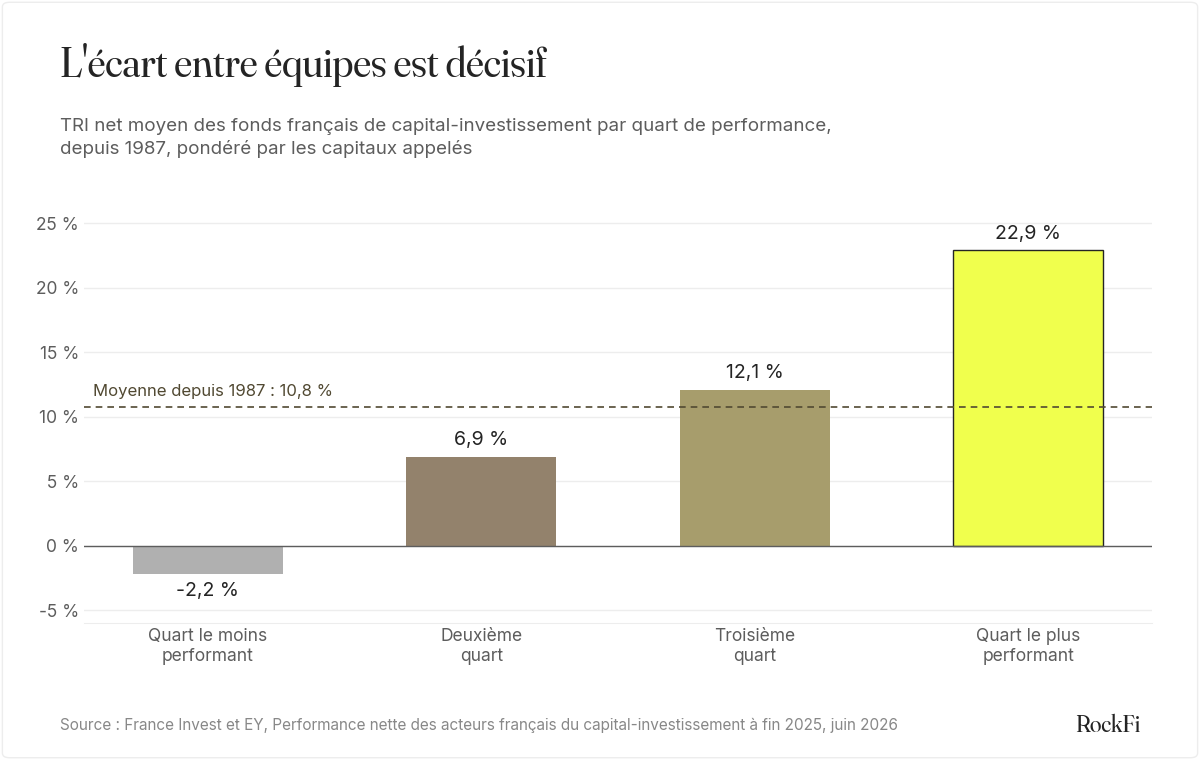
Past performance. It is not an indicator of future results and is not guaranteed.
"In unlisted assets, more than in any other asset class, you really need to know the investment teams. What matters is the team's performance and the stability of that team."
Pierre Marin, co-founder and CEO of RockFi
How much, and at what pace
An allocation to unlisted assets should be sized relative to your total financial wealth: between 5% and 20%, spread across several vintages and several teams.
The share of your portfolio
The ceiling depends on your liquidity needs over ten years, what illiquid assets you already hold, including property, and your tolerance for the lack of reliable valuation in the early stages.
The J-curve and vintage years
A professional fund calls for your commitment in tranches over three to five years, then begins distributions from the fifth or seventh year. Initial valuations are often negative while fees accrue and holdings develop: this is the J-curve. Committing 100,000 euros does not mean paying it out on day one, but keeping it available for the duration of the capital calls.
The vintage is the year the fund makes its first investment. According to France Invest data, the 2011 and 2015 vintages exceeded 14% net IRR, while the 2010 and 2022 vintages remained below 8.5%. No one knows in advance which will perform well. Investing the same amount each year over three to five years reduces this risk without eliminating it.
Good to know. Evergreen funds, which accounted for 72% of assets held by private individuals at the end of 2025 (France Invest), offer periodic, capped exit windows. This liquidity comes at the cost of holding uninvested cash, and windows may close if too many investors exit at the same time.
How the profession is changing
Opening up private equity to private individuals is shifting the value of advice. In the past, the adviser provided access, which was rare and therefore expensive. Today, what is rare is the ability to choose.
Five questions clients are now asking
Clients know that the top quartile performs twice as well as the average. They are now asking questions in writing that require hard figures.
- What are the total fees, including all layers, as an annual percentage and in euros on my investment?
- In which performance quartile were this team's previous funds, and is it the same team?
- What is the projected schedule for capital calls and initial distributions?
- What happens if I need to exit before the maturity date: discount, window, secondary market, or nothing at all?
- How will my performance be measured? An IRR and a change in net asset value do not mean the same thing; the calculation method must be understood line by line.
An adviser who cannot answer these questions is not advising; they are merely distributing.
Selecting rather than distributing
An advisor's remuneration model can create a conflict of interest: a fund that pays higher commission might be prioritised. So, ask the question: how are you paid, and by whom? At RockFi, we offer a service where the pricing is fixed, known in advance, and does not change based on the fund you choose; assets are selected using an open-architectureapproach: direct funds when the ticket size allows, and funds of funds when diversification requires it.
Assembling, not stacking
Private equity is not an end in itself. It is a building block that captures an illiquidity premium that the rest of the portfolio, which is liquid and listed, cannot offer. Our consultants We therefore begin with the allocation and the objective served by this portion. Our white paper on private equity details this approach strategy by strategy; the one on listed index funds describes the liquid portion with which it integrates.
Sources
- France Invest and EY, Net performance of French private equity at end-2025, June 2026: https://www.franceinvest.eu/etude-sur-la-performance-nette-du-capital-investissement-francais-a-fin-2025/
- France Invest, Access to private equity for savers in 2025, April 2026: https://www.franceinvest.eu/thematique/activite-du-capital-investissement/
- AMF, General Regulation, articles 423-27 and 423-49
- Légifrance, Insurance Code, article R131-1-2
- AFG, ELTIF 2 practical guide, January 2025: https://www.afg.asso.fr/app/uploads/2024/10/AFG-Guide-ELTIF-FR-MAJ-2025.pdf
- Order of 1 July 2024, managed portfolio grids (Green Industry Act)
- General Tax Code, Article 150-0 B ter, as amended by the 2026 Finance Act
Disclaimer
This article is for educational and informational purposes only. It does not constitute personalised investment advice or a recommendation to buy or subscribe to any financial product. Unlisted funds carry a risk of capital loss, limited liquidity, and a long lock-up period. Past performance is not a reliable indicator of future results. The figures cited are from dated public sources and are subject to change. Before making any decision, please consult an authorised advisor who can analyse your personal situation, objectives, and risk tolerance. RockFi is registered with ORIAS under number 23004556 as a financial investment advisor, insurance broker, and banking and payment services broker, regulated by the AMF and the ACPR, and is a member of Anacofi.

.webp)