Wealth management: five criteria for comparing offers in 2026


Wealth management has never offered as many entry points as it does in 2026: private banks, independent financial advisers, online management, fixed-fee firms, and family offices. All promise support that meets your specific needs.
Behind this abundance, there is a real risk. On a million euros, the difference between two pricing models can amount to thousands of euros every single year. Yet many savers cannot answer one simple question with a single figure: how much does my wealth management actually cost me?
The word "credible" has no regulatory definition. However, regulations do mandate transparency regarding costs, and public data allows for direct comparison.
This article sets out five criteria for evaluation, scrutinises six models, quantifies the differences, and provides a method for making your decision.
In brief
- According to the RockFi framework, credible wealth management in 2026 is judged on five criteria: total cost as a single figure, remuneration decoupled from products, an open investment universe, genuine human availability, and a clear measure of net performance.
- Layers of fees add up quickly: for unit-linked products, the market average reaches approximately 2.5% per year in total (France Assureurs, May 2026).
- The remuneration of 81% of advisory firms remains tied to the products they distribute (AMF, December 2025); advisory fees are growing, but only slowly.
- Example: over fifteen years and one million euros, the difference between 1.2% and 2.5% in annual fees represents approximately 300,000 euros (simplified assumptions, excluding performance forecasts).
- At the end of 2025, Europe reached a provisional political agreement to more strictly regulate retrocessions; it still awaits formal adoption. The trend is clearly towards greater transparency.
Five criteria for evaluating an offer in 2026
A wealth management offer can be judged against five simple questions, asked in writing, with quantified answers. These criteria measure the alignment between what you pay and what you receive, rather than the prestige of a brand.
Total cost as a single figure
Since 2018, the European MiFID II directive has required full disclosure of costs: the information exists, the question is whether you are given it in one line or sixty pages.
Advisory remuneration
When paid by the products they recommend, an adviser is subject to bias, no matter how honest they are; when paid by fees known in advance, they separate advice from sales. This is the regulatory boundary between independent and non-independent advice.
The investment universe:
All asset classes, including index funds, across multiple management firms, rather than primarily focusing on in-house products.
Theadvisor availability
The number of families each advisor manages affects their availability: this is just as valid a question as the price.
Measuring performance
Being able to answer the question "how much have I earned, net of all fees" with a single figure, using an explicit calculation method.
Table 1. The five criteria and the questions to ask (assessment framework, September 2026)
Five direct questions.
Source: RockFi summary based on MiFID II disclosure requirements.
Good to know.Since 1 July 2022, every insurer has been required to publish a standardised fee table for their life insurance and retirement savings plans, following the February 2022 industry agreement, which allows for comparison before signing up.
The 2026 landscape: six models under the microscope
Six major models define the market in France, none of which is inherently good or bad. Here they are, evaluated against the five criteria, starting with the most recent.
Fixed-fee private wealth management: the rising model

A new model has taken hold: private wealth firms that charge for advice via fixed fees, known in advance and independent of the products recommended, which are provided at cost in share classes without retrocessions. Price becomes a clear figure, performance becomes measurable, and recommending an index fund is no less profitable for the advisor than active management.
This model already dominates elsewhere, starting with the United Kingdom, which banned retrocessions at the end of 2012.
"On 31 December 2012, the UK banned retrocessions. The top ten players at the time were private banks. Today, not one of them remains in the top ten. The UK's top ten players are now next-generation independent financial advisors, with fixed pricing and a technology-driven model."
Pierre Marin, co-founder and CEO of RockFi
In France, this is the model RockFi champions: a dedicated private advisor, formerly a private banker, who manages a limited number of families, with afixed feeknown in advance and aopen-architectureselection of over 3,000 investment vehicles, for portfolios starting from 250,000 euros. For other RockFi offerings, the remuneration method is specified before any commitment is made.
Traditional private banking: real strengths and a complex fee structure
Private banking retains two strengths that few competitors can match: the depth of its engineering, from wealth-based lending to international operations, and its institutional stability, which is invaluable when managing assets across generations.
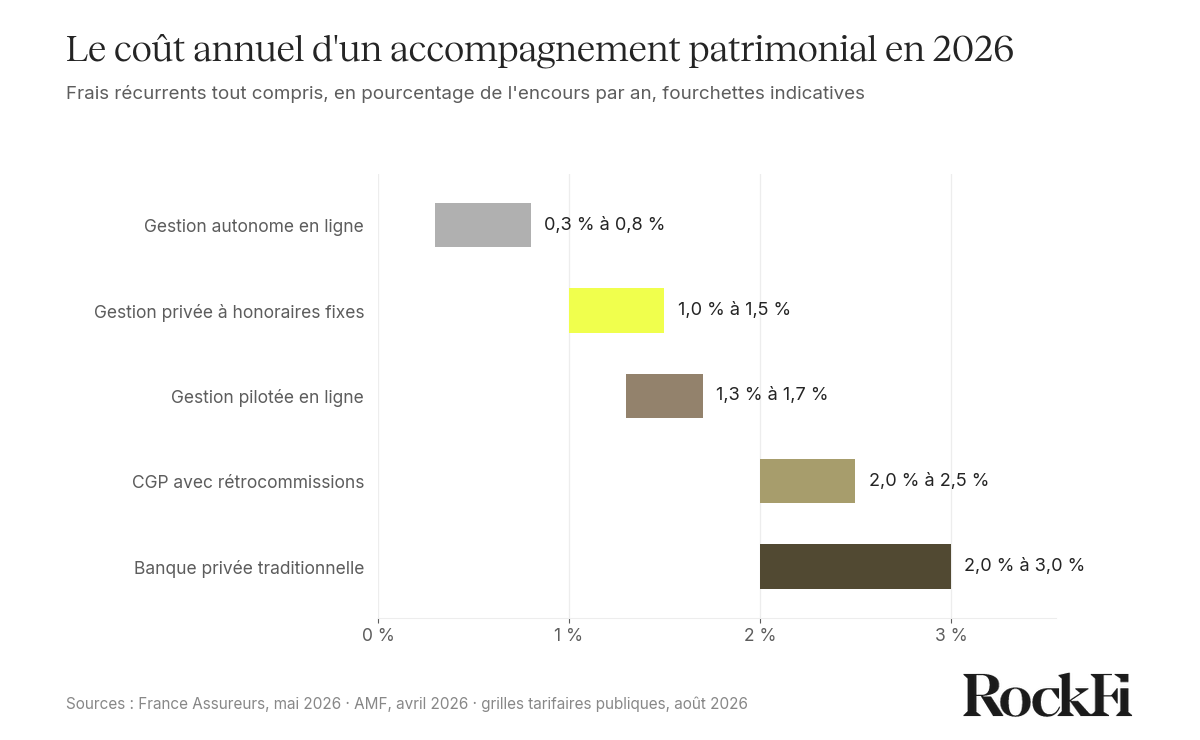
Their main concern lies elsewhere: the transparency of costs. Remuneration can stack up in layers—contract or mandate fees, investment vehicle fees (sometimes in-house), and transaction commissions. While each layer is documented, they are not always totalled up. For unit-linked policies, the market average stands at0.88% in contract feesmore1.60% in recurring fund costs, or approximately 2.5% per year, with discretionary management fees adding an average of 0.36 percentage points (France Assureurs, 2025 and 2026 studies).
"For a client with a few hundred thousand or several million euros, advice costs between 2% and 2.5% in total. If you have a million euros, that’s 25,000 euros every single year. Half goes to the product, the other half to the private advisor."
Pierre Marin
Wealth management advisors: a local model in transition
The wealth management advisor (CGP) is the quintessential trusted local partner: providing long-term support, family knowledge, and a wide range of contracts. According to the AMF, France had 7,013 financial investment advisors at the end of 2024, an increase of 4.5% over the year.
The business model, however, is in transition. Still according to the AMF,81% of firms operate as non-independent advisors, remunerated via retrocessions: in 2024, these still accounted for 88% of the revenue of wealth-focused firms, compared to 12% from fees, an increase of three percentage points over the year.
Autonomous online management: unbeatable on price, solitary on strategy
For the autonomous investor, the online offering has become very inexpensive. Exchange-traded funds (ETFs) that track indices like the MSCI World have average annual fees of 0.33% for equities, compared to around 1.3% for actively managed funds (AMF, Observatoire de l'épargne newsletter, April 2026). The same trend applies to brokerage: in January 2026, a 1,000-euro order cost an average of 0.65% at a retail bank, 0.45% at an online broker, and around 0.15% at a neo-broker.
The limitation isn't the price; it's everything else: allocation, tax planning, and discipline during market downturns. Autonomy is suitable for simple portfolios but can falter at the first major life event, such as a sale, inheritance, or expatriation.
Online discretionary management: standardised delegation
Online discretionary management delegates allocation to a manager, most often using index funds, for an all-inclusive cost generally between 1.3% and 1.7% per year (based on fee schedules published by major players, consulted in August 2026). It is a serious and transparent entry point for methodical investing.
Its limitation lies in its format: standardised profiles, little wealth engineering, and no dedicated contact person. The delegation covers the portfolio, not your life strategy.
Family offices: the gold standard for bespoke service, out of reach for most
The family office, a structure dedicated to the wealth of a single high-net-worth family, remains the benchmark for bespoke service: family governance, total consolidation, and dedicated teams. Its cost restricts it to portfolios of several tens of millions of euros. It is the space between retail banking and the family office that new models are seeking to serve.
Table 2. Six support models compared
The table compares the six models based on key criteria, showing indicative recurring cost ranges, excluding one-off fees.
Sources: France Assureurs, May 2026; AMF, December 2025 and April 2026; public fee schedules, August 2026. Indicative ranges. Based on observed market practices; actual costs depend on the specific offer.
Annual recurring costs by service model
The chart puts these ranges into perspective. Indicative ranges; actual costs depend on the specific offer.
The real cost: a difference of hundreds of thousands of euros
A difference in fees may seem trivial in any given year, but compound interest turns it into a significant gap in capital: every euro taken in fees stops generating returns in subsequent years.
To put this into perspective, let’s take a simplified, hypothetical example: one million euros, an assumed gross annual return of 5%, with no deposits or withdrawals, and two levels of recurring fees: 1.2% and 2.5%. These assumptions are for illustrative purposes only and do not constitute a forecast. In the first year alone, the difference reaches 13,000 euros. In other words, over 1,000 euros per month.
Table 3. Final capital based on fee levels, hypothetical example (€1,000,000, 5% gross annual return)
Simplified assumption: net return equals gross return minus fees, annual compounding, excluding tax.
Source: RockFi calculations based on the assumptions above. This is an illustrative example and does not predict future performance.
One million euros, two fee levels, fifteen years of growth
Two trajectories, with a gap that widens year after year.
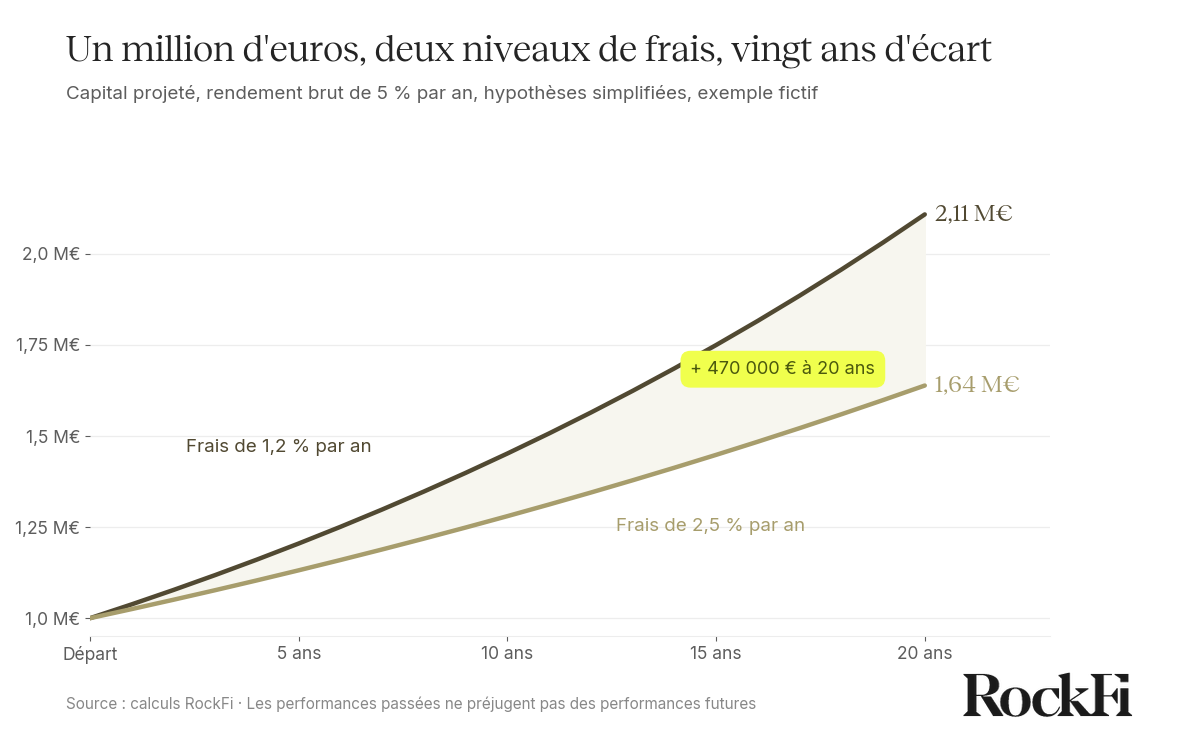
The conclusion is not that the cheapest option always wins: quality advice comes at a price and is often worth far more than it costs. The conclusion is thatcosts must be known, chosen, and weighed against the service provided: price is a benchmark of value, allowing you to assess the service and decide, year after year, whether to stay or leave.
Good to know. VAT treatment differs depending on whether fees are invoiced directly or deducted from a contract. Some fixed-fee providers therefore have their fees deducted from the contract at the agreed rate. Tax implications depend on individual circumstances and are subject to change.
What is changing in the profession in 2026
The profession is undergoing three simultaneous shifts: regulatory, generational, and technological. The credible players of the decade will be those who face them head-on.
Regulation is tightening around retrocessions
On 18 December 2025, the European Parliament and the Council reached a political agreement on the European Retail Investment Strategy. This provisional agreement still needs to be formally adopted. The text does not ban retrocessions, but it does strictly regulate them: a tangible benefit must be demonstrated, they must be proportionate to the service provided, costs must be presented separately, and each Member State retains the right to ban them. This direction follows the British (2012) and Dutch (2014) precedents: advice is increasingly being paid for through fees rather than commissions.
The great wealth transfer is reshuffling the deck
More than €9,000 billion could be transferred in France between 2025 and 2040, with the annual flow of inheritances and gifts rising from approximately €464 billion to €677 billion, according to a report published in late 2024 by the Fondation Jean-Jaurès based on work by the Council of Economic Analysis and INSEE. However, heirs want transparency on fees and performance, digital journeys, and purpose: when wealth changes hands, the advisor is re-evaluated.
Clients are verifying, artificial intelligence is accelerating
Savers now arrive at meetings with data. The AMF has counted more than 1.1 million French people who carried out at least one ETF transaction in 2025, an increase of 83% over one year, with the average age falling from 41 to 38 (March 2026 dashboard).
At the same time, artificial intelligence allows everyone to monitor an allocation, fee levels, and performance, while freeing up time for advisors to spend with their clients. Technology does not replace judgment: it exposes those who lack it and amplifies those who possess it.
Remuneration for advisory firms is slowly shifting towards fees
The breakdown of income for wealth-focused financial investment advisors is evolving.
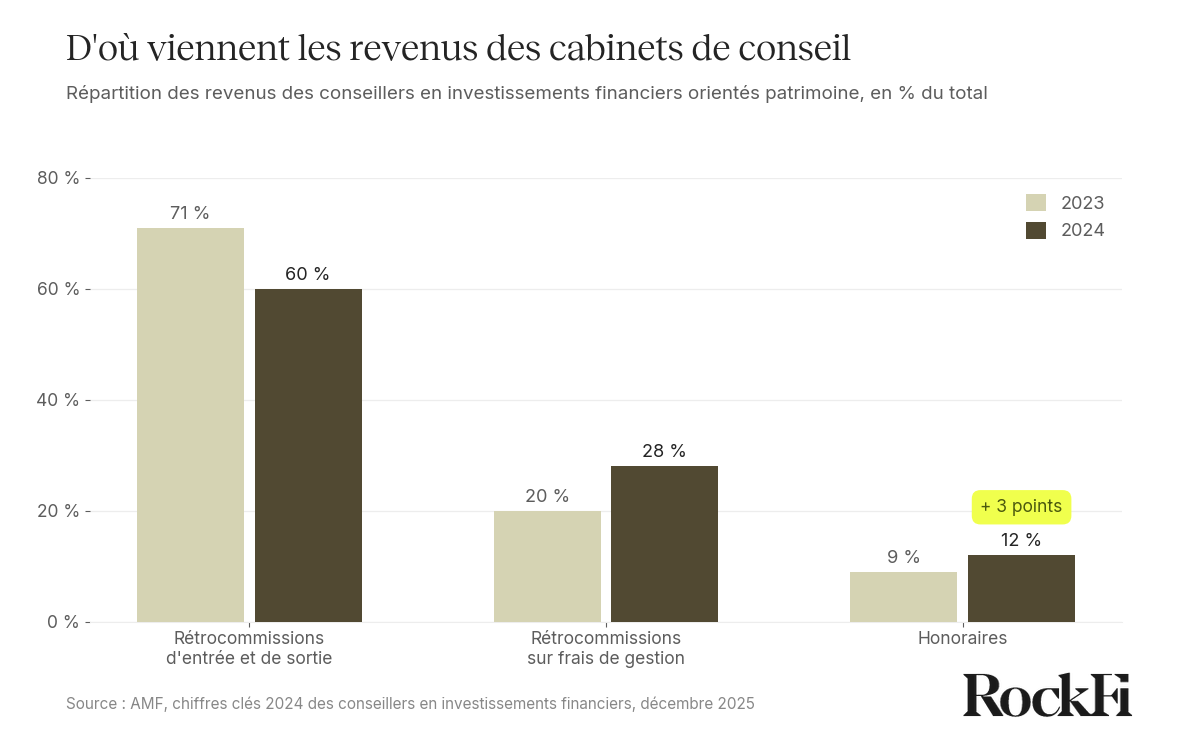
Our conviction: advice has a price, and that price must be known. When remuneration depends on recommended products, a bias in the advice can emerge, no matter how honest the advisor; fixed pricing removes this at the source. Other mechanisms (independence, transparency regarding retrocessions) provide further regulation. It is a choice of model, not a judgment of individuals : France has excellent private bankers and wealth management advisors.
How to choose: the four-question method
The right choice depends less on the brand than on the order of the questions. Start with yourself, end with the price.
First question: what is the objective?
Wealth is managed to support life goals, prepare for a business sale, protect your family, plan for succession,and fund your retirement. A professional advisor starts with these questions, never with a product.
Second question: how complex is your situation?
For assets under a few hundred thousand euros, disciplined online management using well-selected index fundsmay be sufficient. As soon as your situation involves holding companies, private equity, succession planning, or tax considerations, human advice becomes invaluable.
Third question: who pays the advisor, and how much?
Ask for the total cost in pounds from the previous year and whether any retrocessions are involved. Both answers should fit on two lines; an advisor must be able to provide them before offering any advice.
Fourth question: how will performance be measured?
Ask for a time-weighted rate of return method, such as the modified Dietz method used by RockFi, which accounts for the timing of deposits and withdrawals. Finally, meet the advisorin person, not just the firm: wealth management remains a business built on trust.
Sources
- France Assureurs, Unit-linked life insurance in 2025, May 2026, franceassureurs.fr
- AMF, 2024 Key figures for financial investment advisors, December 2025, amf-france.org
- AMF, Savings Observatory Newsletter No. 65, April 2026, amf-france.org
- AMF, Retail Investor Dashboard No. 21, March 2026, amf-france.org
- Council of the EU, agreement on retail investment, 18 December 2025, consilium.europa.eu
- Jean-Jaurès Foundation, Tax on large estates, November 2024, jean-jaures.org
Disclaimer
This article is for educational and informational purposes only. It does not constitute personalised investment advice, a recommendation to buy or sell financial instruments, or tax or legal advice. It compares support models, one of which is offered by RockFi. All investments carry a risk of capital loss, and past performance is not a reliable indicator of future results. The numerical examples are fictitious and based on simplified assumptions. Projections are not a reliable indicator of future performance. Tax treatment depends on individual circumstances and is subject to change.
Before making any decisions, please consult a qualified advisor who can analyse your specific situation. RockFi is registered with ORIAS (No. 23004556) as an insurance broker, financial investment advisor, and broker in banking operations and payment services, regulated by the AMF and the ACPR, and is a member of Anacofi.


.webp)