How is your performance calculated?

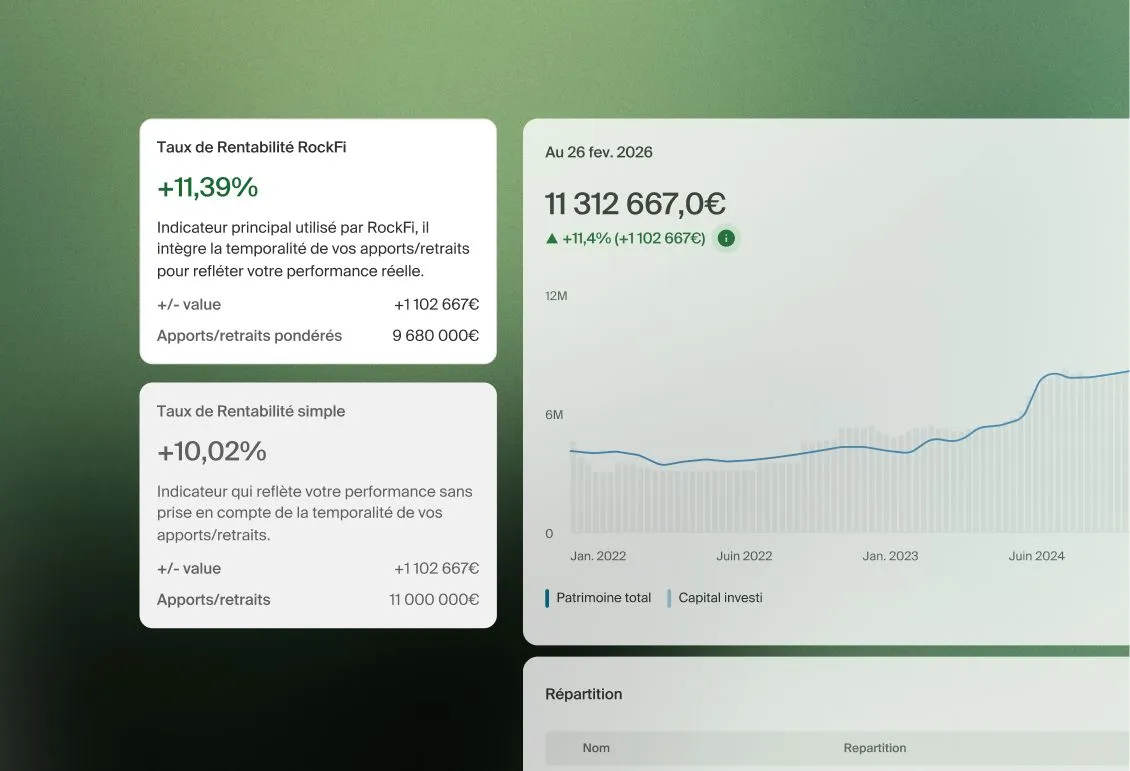
This page provides a transparent overview of the method RockFi uses to measure the performance of your assets, the reasons behind this choice, and practical examples to help you understand the figures displayed in your app.
The different calculation methods
There are several common approaches used to calculate portfolio performance. Each one answers a different question.
Simple performance
This divides the unrealised gain by the total capital invested over the period. It is easy to understand, but it completely ignores the timing of your deposits or withdrawals. Two clients can end the year with the same gain in euros while having had very different investment experiences.
Time-weighted performance
This divides the unrealised gain by the time-weighted capital invested over the period. Money held in the portfolio for longer periods reduces the performance figure. It measures the performance of your experience as an investor: what your money actually generated, based on when you invested it.
A practical example to understand these methods
Here are two clients, Marie and Paul, who end the year with exactly the same gain of€10,000.
Marie invested €100,000 for the entire year. Paul only invested €20,000 for most of the year, and added €80,000 just 30 days before the end. If we used a simple performance calculation, we would arrive at the same performance of+10%for both clients. Now let's see what their performance would be using the time-weighted method.
Calculation for Marie
Weighted capital = €100,000
Rate = 10,000 / 100,000 = +10.0%
Calculation for PaulDecember contribution weighting = (365 − 335) / 365 ≈ 0.082
Weighted Capital = 20,000 + (80,000 × 0.082) = 20,000 + 6,560 = €26,560
Rate = 10,000 / 26,560 ≈ +37.6%
In other words, Paul had an average of €26,560 tied up over the year — this is the base used to calculate his performance.
The unrealised gain in euros remains the same (+€10,000), but the percentage performance is very different. This is because Paul had much less money tied up than Marie to achieve this unrealised gain. The weighted method therefore reflects this reality.
The RockFi choice: weighted performance
RockFi has therefore decided to use theModified Dietz method,an implementation recognised for representing weighted performance. This choice is based on several convictions:
- Precision that reflects your reality.The Modified Dietz method is the most accurate indicator for measuring the performance of your assets, taking into account how long your money has been tied up — as we just saw in the previous example.
- An indicator net of fees.The rate displayed includes all management fees. What you see is what you have actually earned, with no further adjustments needed.
- A proven market standard.The Modified Dietz method is recommended by the GIPS (Global Investment Performance Standards) and is adopted by the leading digital wealth management platforms in France.
- Consistency at every level.RockFi applies this same indicator to portfolios, contracts, asset classes, and products. You see the same type of performance everywhere, calculated in the same way.
The formula in detail
In our reporting application, you will find theRockFi Rate of Return(which uses the Modified Dietz method), calculated as follows:
RockFi Rate of Return= Net Gain / Weighted Capital
Net Gain(or net unrealised capital gain): this is the gross economic result of your portfolio over the period - the final value, minus the starting value and any contributions made, plus any withdrawals.
Net Gain =Final Value - Initial Value - Contributions + Withdrawals
Weighted Capital: this is the reference capital, adjusted to reflect the time each cash flow has been held in the portfolio.
Weighted Capital =Initial Value + Σ (Cash Flow × Time Weight)Time Weight =(Days remaining in the period) / (Total duration of the period)
A contribution made halfway through the period has a weight of 0.5. A contribution made at 90% of the way through the period has a weight of 0.1 - it has been invested for a short time.
What the RockFi rate includes
- Unrealised capital gains and losses (increase or decrease in the value of your assets)
- Distributed income: dividends, coupons, rental income
- Management fees (deducted - net performance)
- All your deposits and withdrawals, weighted by their date
What the RockFi rate does not include
- Social security contributions (while these do reduce the surrender value of your policy,we do not include them in the performance calculation)
Why discrepancies may appear compared to other documents
You may sometimes notice a difference between the performance displayed in your RockFi account and other indicators, such as insurer statements, surrender values, or simply the difference between your cumulative deposits and the current value of the policy.
One of the most common reasons for this is that every insurer uses its own calculation methods.


.webp)